
South Korea - KORADIS - GDF GSF - horizontal TBM drill 1,75 m - Hardrock or what ? KBS-3 if welding succesful ? Your approach offers a lot of good options - Lets work on the plans - book service - will you do any proof of undercriticality in GDF under earthquake ?
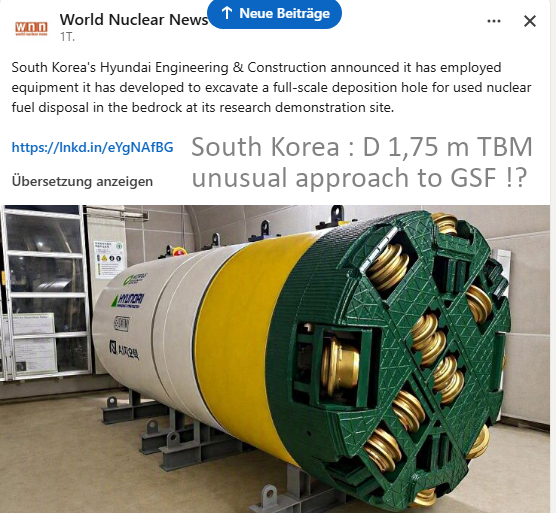
https://www.world-nuclear-news.org/articles/hyundai-ec-tests-repository-excavation-equipment
>>> South Korea - shows TBM D 1,75 m - but what ? could be the relation to GDF. - There is nothing - they just want to show that South Korea is able to produce a clever TBM and they really want to demonstrate this machine - in hardrock - for loooooooong deep boxhole drillings. KBS-3 is D 1,05 m - New Container in South Corea too ? Put the load on a rolling bed. But the air around is not a good heat transmitter - But nice try - Do you need GDF mine plans ? Lets do some international planning - how much critical masses we can expect in your container ? Why drilling storage holes and leaving empty corridors ? You can start drilling now in a similar hardrock - Drill into a hill. 50 m. Horizontal - a little upwards. Make it a payed job for Ing. Goebel and Team.
- KORADIS-V (Vertikale Lagerung): Die hochradioaktiven Abfallbehälter (bestehend aus einem korrosionsbeständigen Kupfermantel und einem Gusseisen-Innenbehälter) werden vertikal in tief in das Festgestein gebohrte Löcher eingelassen und mit Bentonit-Blöcken als Barriere versiegelt. [1]
- KORADIS-H (Horizontale Lagerung): Hierbei werden sogenannte „Supercontainer“ (vorverpackte Einheiten aus Abfallbehälter und Puffermaterial) horizontal in Tunneln platziert. Diese Methode reduziert das notwendige Aushubvolumen erheblich. [1]
- Gesetzliche Fristen: Ein im Februar 2025 verabschiedetes Sondergesetz sieht den Bau von Zwischenlagern bis 2050 und eines permanenten Endlagers bis 2060 vor. [1, 2]
- Automatisierte Bohrtechnik: Erst im Oktober 2026 hat das südkoreanische Bauunternehmen Hyundai E&C eine neuartige, KI-gestützte Bohrmaschine mit einklappbarem Schneidkopf erfolgreich in einem Forschungstunnel getestet. Diese Technologie ist präzise auf die KORADIS-Spezifikationen zugeschnitten und soll das umgebende Gestein schonen, um unterirdische Wasserwege zu vermeiden. [1, 2]
Send us geology and location data if you have
Otherwise we work generic in hardrock for you.
Send us your HLW amounts in Mg all types
Send us your GDF Container data sheets
Your get :
- Site plan with TBM driled main corridors
- Horizontal storage in D 1,75 storage holes
. Vertical storage in vertical storage holes
. full CAD mine Plan 1:20.000 - 1:10.000
- Detail plans of Mine 1: 500, 1:200, 1:100
- for Shaft plans you have to ask Redpath
- show photos from D 1,75 m test drills
Oppenheimer had Trinity, 16 and 22 kg
we have a lot more today and our task
is long term nuclear safety.

 Druckversion
Sitemap
Druckversion
Sitemap
Architekt CH / Volker Goebel / Dipl.-Ing. / Tel: +49 157 546 624 34 DE / archi.goebel@gmail.com / info@ing-goebel.com - - - - - Konnten am 08.03.2025 nach 14 Jahren eine vollständige Endlager-Planung nachweisen.
